Wednesday, 29 March 2017

BSA 106 Kuleshov effect

Today we did an experiment on the Kuleshov effect. For the main image I used a stock photo of a clock:
Image source: https://pixabay.com/en/clock-time-pointer-time-of-watches-705672/

Juxtaposed with the clock, I included these three images:

Image Source: http://www.bbc.com/news/education-34044171

This image, coupled with the clock, was used to convey the tension of time passing in an exam.


Image Source:  Mrs myrtle brewer from Stockton (https://clipartfest.com/download/2d362b127d796b9b7b872b714104473a656f5070.html)

This image, coupled with the clock, was used to convey the urgency of being late

 
Image Source:  http://www.thedailymind.com/how-to/17-ways-to-wake-up-feeling-fresh-in-the-morning/

This image, coupled with the clock, was used to convey the reluctance of getting up too early in the morning

Aside from the low image quality of the exam picture, I feel that the juxtaposition of the images managed to successfully convey the emotions I was trying to convey.


Wednesday, 22 March 2017

BSA 106 week 6

During the Russian revolutions (a period of social and political upheaval in the early 20th Century), there was a large demand for propaganda. After this period of unrest, film makers experimented with the old footage in new ways.
D. W. Griffiths work helped influence Russian film makers by introducing cross cutting and montage.

Sergei Eisenstein
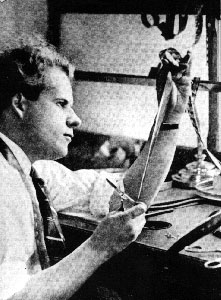
Image result for sergei eisenstein

Heavily influenced by the cultures that emerged after the Russian Revolution. He used five different methods of montage:

Metric

Where shots are edited purely by timing alone (e.g. one shot every two seconds)

Rhythmic

Where shots are edited according to a scene's internal rhythm and continuity.

Tonal

Where shots are edited for emotional effect, i.e. shot length is determined by their emotional meaning

Overtonal

An combination of Metric, Rhythm and Tonal montage types for a more complex effect

Intellectual

Uses a combination of shots outside the film to create a meaning (i.e. juxtaposing a shot of cattle being murdered into a massacre scene to drive home the 'murdered like cattle' simile)

Dziga Vertov

Image result for dziga vertov

A newsreel cameraman, credited with coining the term Kino-eye (camera-eye), and one of the earliest Russian animators.
Believed conventional storytelling to be corrupting and false, and placed emphasis on the truth of cinema. Tried to make a cinematic 'language' unique from theatre, literature etc.
Cut his films to generate thematic connections, or for the emotional effects of juxtaposition, making a montage style unmatched until the era of the music video. His work and theories influenced documentary realism (cinema verite) in the 1960s.

Vsevolod Pudovkin

  Image result for vsevolod pudovkin

Theorised that it is not the actors on the screen that act, it is their context in which they are acting which draws an emotional response from the viewer. Believed that the eye of the camera should be treated as if it were the eye of the viewer and details such as camera angles can have thematic importance. Believed montage operated differently than Eisenstein, where it was a linkage of frames, rather than a collision of frames.

He is credited with coming up with the five editing techniques:

 Contrast

Where conflicting shots are juxtaposed with each other to drive comparison of two (or more) seemingly disparate events

Parallelism

Where scenes with similar visual elements are juxtaposed next to each other to drive comparison. Often used for things like time skips, which shows how the same person has changed over time

Symbolism

Where two shots are juxtaposed to provide a visual metaphor

Simultaneity (cross-cutting)

Where scenes are shown to be happening at the same time by juxtaposing them with each other

Leit Motif

A recurring visual element or musical phrase associated with a person, place or idea (e.g. emperors march in Star Wars)

Wednesday, 15 March 2017

Birth of a nation research (BSA 106)

Birth of a Nation Research

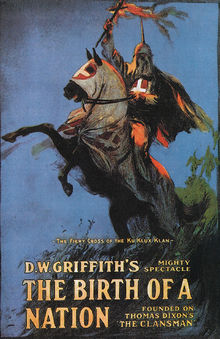
Birth of a Nation is based on a book titled The Clansman: A Historical Romance of the Klu Klux Klan, Written by Thomas Dixon Jr. The 1915 film Birth of a Nation gained controversy by portraying the KKK as the heroes of the film, leading a righteous crusade against the newly-freed (and riotous) former slaves in the southern US. The KKK used this film and its imagery as a recruiting tool to bolster their numbers, due to its portrayal of the KKK as righteous heroes and black men (white actors in blackface) as primitive savages who want to rape white woman.


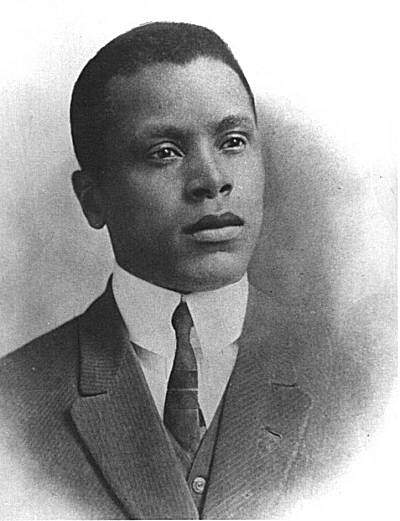
Image result for oscar Micheaux
Oscar Micheaux

In response to Birth of a Nation, Oscar Micheaux wrote Within our Gates, which provided a different (African-American) perspective of similar themes present in Birth of a Nation. The film encourages sympathy of the individuals being lynched rather than the lynchers.


https://upload.wikimedia.org/wikipedia/commons/thumb/e/eb/Film_still_of_lynching_from_Micheaux%27s_Within_Our_Gates.jpg/220px-Film_still_of_lynching_from_Micheaux%27s_Within_Our_Gates.jpg


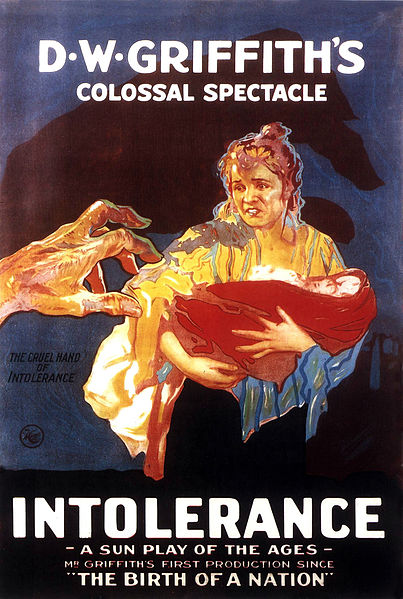
As a result of Birth of a Nation's controversy, D. W. Griffith made a follow-up film, called Intolerance, in 1916.
File:Intolerance (film).jpg

BSA 106 D. W. Griffith

D. W. Griffith

An influential American Film maker who was inspired by and borrowed techniques from Porter, Guy, Melies and others. From 1908-1913 he made ~450 short films while working for the Biograph Company, in a time period where films were often quite short, not rehearsed beforehand and considered "low" or "cheap" entertainment. During this time, he made films that appealed to a wide audience ("Don't look down upon your audience" -quoted by one of his former actresses) and improved the reputation of the motion picture
When he wanted to branch out into longer, more costly films, he left the Biograph Company and eventually made the feature-length film, The Birth of a Nation (1915).
Image result for birth of a nation
 For obvious reasons, this film is considered controversial.

 It's two-hour length (unusual for a film at the time), as well as editing techniques and well choreographed acting and action, resulted in Birth of a Nation being considered a masterpiece in which was praised by the US president at the time (a statement that was later rescinded).
 

BVA 142 blog excercise


Before image editing

I emphasized the shape of the lamp in the picture by adding both hue/saturation and Brightness/Contrast layer masks to highlight it's silhouette.


After image editing

Sunday, 12 March 2017

BSA 126 scrapped characters for assignment 1

For the first assignment in BSA126, we were tasked with creating a character. I made (and subsequently scrapped) two characters before settling on my assignment character.


 The first scrapped character was a mermaid based on a Scamp Grouper (Mycteroperca phenax). This character ended up scrapped as future assignments would involve walk cycles, which require a character to have legs.


The second scrapped character was a selkie based off the extinct tropical Caribbean monk seal (Neomonachus tropicalis) and was scrapped due to not being able to figure out a story and narrative to go with this character.


The character I ended up settling on is a (human) scientist, possessing both legs and (most of) a backstory.


Wednesday, 8 March 2017

BVA 142 Assignment 1 progress

Assignment 1

I have started research on my powerpoint presentation, Humans and Technology- the 3D printer. It has gotten really technical, really fast and I am currently unsure how in-depth the assignment criteria requires me to go as it also states that this is also a proposal for a putative project and this may result in difficulty in keeping to the 6-10 minute timeframe given. I have been able to generate some slides detailing some of the functions and history of the 3D printer, and there is no shortage of resources available on this subject.